
Call Center Jobs Are Declining, but 14,000 Calls Show Humans Still Outperform AI
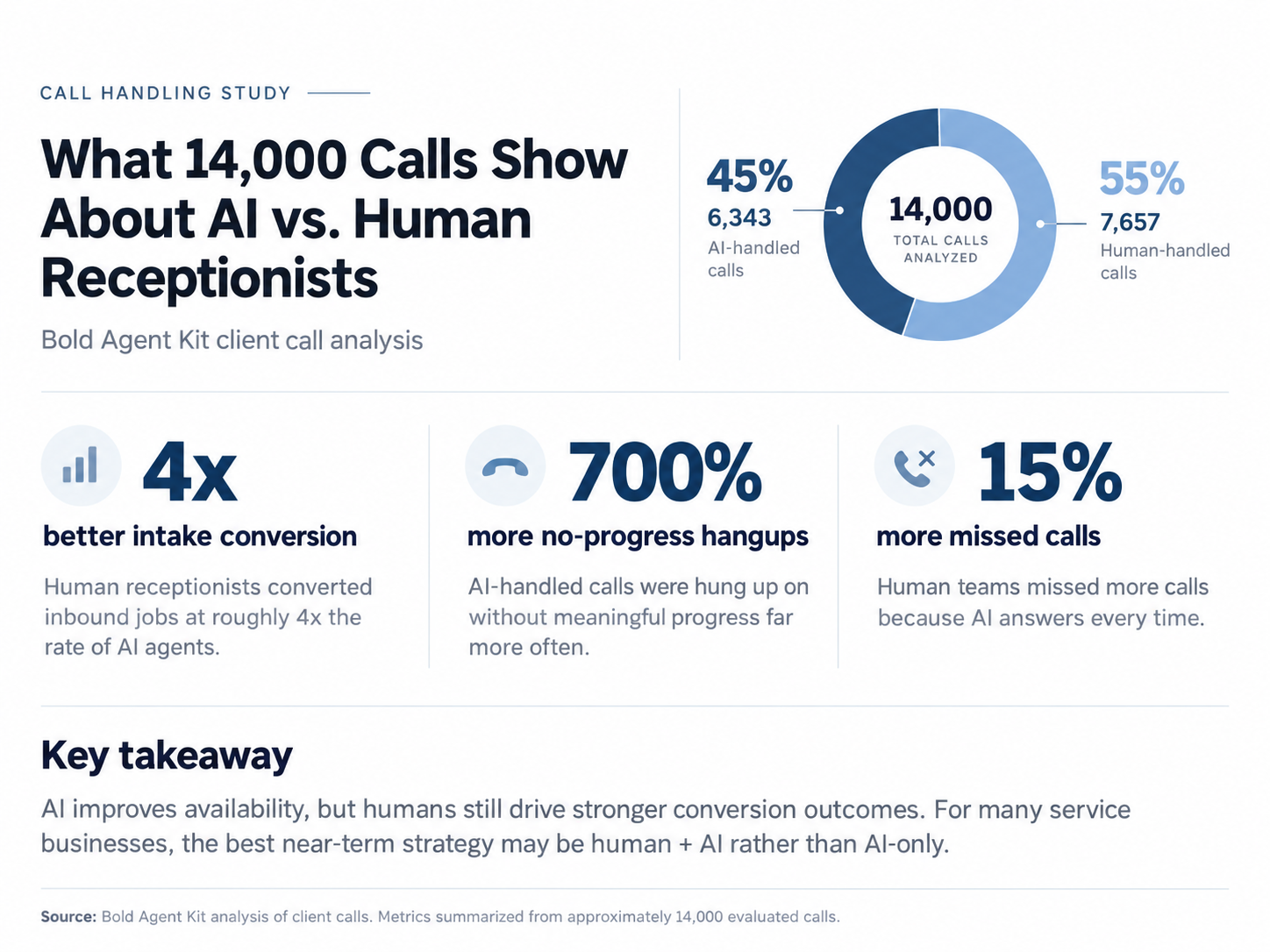
New research from Bold Agent Kit finds that human receptionists delivered approximately four times stronger inbound intake conversion performance, despite AI answering more calls.
Artificial intelligence is rapidly changing the economics of customer service. Companies are deploying AI receptionists, automated call handlers, and voice agents to reduce labor costs, extend operating hours, and handle growing call volumes without expanding their workforce.
And the impact on employment is beginning to show.
An October 9, 2026, report from Andreessen Horowitz (a16z), citing employment data from Revelio, highlighted a significant decline in global call-center employment growth. After more than a decade of largely consistent expansion, call-center employment growth has turned negative across income groups.
The report raises an important possibility: AI may already be contributing to the displacement of call-center workers.
But at Bold Agent Kit, a platform that enables businesses to build and deploy AI receptionists and communication agents, we wanted to examine a different question.
Just because AI is replacing human workers, does that mean it is performing their jobs better?
Our analysis of approximately 14,000 customer calls suggests the answer is far more complicated than the industry's enthusiasm for automation might imply.
The Study: 14,000 Calls, Human vs. AI
Working with our clients, Bold Agent Kit evaluated approximately 14,000 inbound calls to compare the performance of AI-powered receptionists with human receptionists.
Of those calls, 6,343 were handled by AI agents, while the remaining approximately 7,657 were assigned to human receptionists.
Our analysis focused on three business outcomes: successful inbound intake conversions, calls abandoned without meaningful progress, and missed calls.
The findings challenged some of the assumptions driving the rapid adoption of AI voice agents.
Key Findings
1. Human receptionists delivered approximately 4x stronger inbound intake conversion performance.
In our evaluated calls, human receptionists substantially outperformed their AI counterparts at converting inbound inquiries into successful intake outcomes.
This is potentially the most consequential finding for service-based businesses.
For a law firm, contractor, medical practice, or other service provider, the purpose of a receptionist is not simply to answer the phone. It is to understand the caller's needs, build trust, collect accurate information, and help move that person toward the next appropriate step.
Answering a call is an activity. Converting that call into a meaningful business outcome is the result.
Our findings indicate that, at least among the workflows we examined, human receptionists were considerably more effective at producing that result.
2. AI-handled calls experienced 700% more no-progress hangups.
Our analysis also found that AI-handled calls had a reported 700% higher incidence of callers hanging up before meaningful progress was made.
That is a particularly concerning outcome for businesses investing in automation to improve their customer experience.
An AI agent may answer immediately, deliver a professional greeting, and follow a carefully designed script. But if callers disengage before completing the intake process, that interaction may produce little business value.
There are several possible explanations for this behavior, including conversational friction, response delays, difficulty handling unexpected questions, or callers' preferences for speaking with a person. Our study did not isolate which factors caused the difference.
Whatever the explanation, the outcome matters.
A call that is answered but abandoned without progress should not automatically be treated as a successful customer interaction.
3. Human receptionists missed approximately 15% more calls.
AI did demonstrate a meaningful operational advantage: availability.
Human receptionists in our study missed approximately 15% more calls than AI agents. AI receptionists can be configured to answer incoming calls consistently, including during periods when employees are unavailable.
That advantage is significant.
Missed calls can represent missed revenue, particularly for businesses where a prospective customer is unlikely to leave a voicemail or call back.
But our data highlights a critical distinction: answering more calls is not necessarily the same as generating more business.
An automated system that consistently answers the phone but struggles to convert callers may not create the economic return a business expects.
Conversely, a human receptionist who converts inquiries effectively but cannot answer every call also presents an opportunity for improvement.
The challenge is finding the right balance.
The Hidden Cost of Replacing Human Receptionists
Much of the business case for AI receptionists focuses on labor savings.
A business might compare the monthly cost of a human receptionist against an AI service that can answer calls around the clock at a fraction of the expense.
Viewed strictly as a staffing expense, the AI alternative can look compelling.
But that calculation is incomplete.
For many service businesses, a receptionist is not simply an operational cost. The receptionist also contributes directly to revenue generation.
Consider a business where each successful intake conversion could lead to a customer relationship worth hundreds or thousands of dollars.
If switching to AI materially reduces the percentage of callers who become customers, the lost revenue may outweigh the reduction in staffing costs.
A system that costs 80% less to operate is not necessarily more profitable if it also converts substantially fewer opportunities.
These are illustrative economics, not a calculated return on investment from our study. Actual profitability depends on call volume, conversion rates, customer value, staffing costs, and the types of inquiries being handled.
The larger point remains: businesses should evaluate the cost per successful outcome, not simply the cost per answered call.
Employment Declines Do Not Prove Performance Improvements
The Revelio employment data discussed by a16z illustrates an important transition in the global labor market.
Call-center employment growth has deteriorated substantially, with the downturn extending across countries at different income levels.
AI is a plausible contributor to that trend, although employment statistics alone cannot establish exactly how much of the decline is attributable to automation rather than broader economic factors.
More importantly, workforce reductions tell us very little about whether customer service is improving.
A company can reduce its headcount, lower operating expenses, and process more calls using AI while simultaneously experiencing declining conversion rates, greater customer frustration, or more unresolved inquiries.
These outcomes are not mutually exclusive.
Efficiency and effectiveness are two different measurements.
Our research suggests that businesses should be cautious about equating one with the other.
The Opportunity May Be Human-AI Collaboration, Not Replacement
None of these findings suggest that AI receptionists have no value.
Quite the opposite.
We operate a platform built specifically to help businesses create AI-powered receptionists and communication agents. We see the value of automating repetitive interactions, extending availability, collecting information, routing calls, scheduling appointments, and handling routine communication.
But deploying AI effectively requires understanding where it performs well and where it currently falls short.
For some organizations, the best approach may be a hybrid model.
AI can answer calls outside business hours, handle straightforward inquiries, gather preliminary information, and route callers to the appropriate person.
Human employees can focus on conversations requiring judgment, empathy, persuasion, nuanced problem-solving, or relationship building.
Rather than treating every human-handled call as a cost to eliminate, businesses can use AI to make their existing teams more productive.
An AI receptionist does not have to replace a human receptionist to generate a meaningful return on investment.
Sometimes, the best application of AI is ensuring that human employees spend more time on the conversations where they provide the most value.
What This Research Does — and Does Not — Establish
Our findings reflect calls evaluated with participating Bold Agent Kit clients. They should not be interpreted as proof that human receptionists outperform every AI system in every industry.
Call complexity, business type, agent configuration, caller expectations, and implementation quality can all affect outcomes.
The analysis is observational rather than a randomized controlled experiment, and differences between the human-handled and AI-handled call populations may have influenced the results. The headline comparisons should therefore be understood as results observed in this dataset, not universal benchmarks or established causal effects.
Future evaluations should also examine absolute conversion rates, revenue generated per inbound call, call complexity, customer satisfaction, and the performance of hybrid human-AI workflows.
Nevertheless, the findings raise a question that deserves greater attention as businesses continue adopting AI communication systems.
Are companies measuring how much work AI eliminates, or how much value it actually creates?
The Bottom Line: Cheaper Is Not Always Better
AI voice technology is improving rapidly, and its economics will continue to change.
It may eventually equal or exceed human performance across many of the customer-facing interactions examined in this study.
But businesses should be careful about assuming that future capability is the same as present-day performance.
Our analysis of approximately 14,000 calls found that human receptionists delivered substantially stronger intake conversion performance, while AI agents demonstrated a clear advantage in call availability.
Both findings matter.
For organizations considering replacing human receptionists with AI, the decision should be driven by measured business outcomes rather than cost savings alone.
The goal of AI adoption should not be to eliminate the most employees. It should be to produce the best outcomes for businesses and their customers.
And based on what we've observed so far, human beings still have a substantial role to play.
Try Bold Agent Kit
Bold Agent Kit lets you build your own communication agents that work across phone calls, text messages, and email. Each agent shares one memory of every customer across those channels, and you decide which conversations it handles and which go to your team.
Build your own multichannel agent with Bold Agent Kit
About Bold Agent Kit
Bold Agent Kit is a platform that enables businesses to build, deploy, and manage AI receptionists and communication agents. The company works with businesses to automate inbound and outbound communications while evaluating the real-world performance of AI-powered customer interactions.
Research: Bold Agent Kit client call analysis, approximately 14,000 calls, including 6,343 AI-handled calls.
External reference: Andreessen Horowitz, This Week in Charts: Are Prediction Markets Politically Biased?, October 9, 2026, section “AI Has Come For Call Centers, After All?”, citing Revelio employment data.