How fast do AI agents for solar installers reply to a new lead?
In seconds, on the channel the lead arrived on. A text is answered on your own number, an email from your own mailbox, a website chat in the widget, a Messenger or Instagram DM inside that platform's reply window. Auto-reply is a separate switch per channel, so you can have it answer texts and chat at night and leave the office line to a person during the day. On phone calls it hears and speaks in real time on your Twilio number, using your provider's fastest model so it does not leave silences, and answering and dialling are separate switches. Every reply is generated from the knowledge base you gave it and stored with the material it used.
Can it pre-qualify a solar lead before a consultant drives out?
Yes, from questions you write. In the agent's instructions you set the questions and their order: whether they own the home, the roof type and age, any shading, the average monthly bill, the utility. It asks them in conversation, takes the answers into the contact record, and follows the rule you gave for each outcome, such as thanking a renter and pointing them to a page you chose, or offering a homeowner with a qualifying bill a consultation slot. It does not score leads on its own or invent criteria; the qualification is exactly what you told it to ask.
Does it actually book the solar consultation, or just send a link?
It books. Connect the calendar your consultants work from, Google Calendar, Microsoft 365, Calendly, Cal.com, Acuity Scheduling, Zoho Bookings, Square Appointments or HubSpot Meetings, and the agent is given your real open slots for the week ahead. It offers a few of them, and when the homeowner picks one, the choice is checked against the slots that were offered, written to the calendar and confirmed in the reply. It cannot book a time that was not free and it cannot cancel an appointment it was not shown. A booking on any channel stops the follow-up sequence on every channel.
How long can the follow-up sequence run?
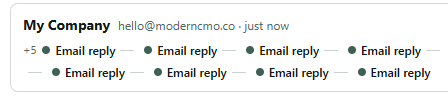
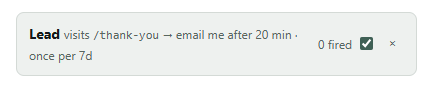
As long as a solar decision takes, which is usually weeks. A campaign is a sequence of email, text and call steps, each with its own delay and its own send condition: opened, not opened, clicked or not clicked. A common solar lead follow-up runs an email on day 1, a text on day 4, a call on day 9, an email on day 16 and a text on day 30, but the days, the wording and the number of steps are yours. It runs inside the days, hours and time zone you set, and stops on that contact the moment there is a reply, a booking or an opt-out.
What does it say about the tax credit and financing?
What you told it to say. Put your incentive answers in as Q&A pairs, your financing partners and terms as data points, and the pages of your site that explain them as allowed pages, and the agent answers from that material and links only to those pages. It does not pull incentive figures from the model's memory, which is the way a wrong percentage ends up in a text. When a question falls outside what you gave it, it says so and, if you wrote the rule, hands the thread to a person.
How do AI agents for solar installers handle TCPA and texting consent?
The controls are built into the text step. It carries the TCPA consent tick with its sending window, the texts-per-hour pace for the number, and the Reply STOP line, and a reply of STOP is honoured on every channel at once, with anything already queued to that person cancelled. Every campaign email carries a one-click unsubscribe. Every message and call is stored against the contact with a timestamp. Whether your leads were consented and your sequence meets the rules where you operate is your decision and your responsibility, as it would be with a setter making the same calls, and the record is there to show it.
Can I run one agent per lead source or per territory?
Yes. Unlimited agents are included in the plan, each with its own identity, number, mailbox, knowledge base, instructions and analytics, and nothing is shared between them. Many installers run one agent for aggregator leads, one for the ad campaign, and one for referrals, so each source has its own funnel and the money goes to the one that books consultations. A dealer with several territories runs one per office on that office's number, and a franchise or a marketing partner can invite each installer into their own agent with a login that sees that agent and nothing else.
What does it cost for a solar company?
The plan is $25 a month or $200 a year for the whole account, with a 14-day free trial and unlimited agents, contacts and lists. There is no per-lead, per-seat, per-message or per-minute charge. You pay your carrier for texts and calls on your own account and your AI provider for the model on your own key, both at cost and typically a few dollars a month per agent. A company buying leads at a few hundred dollars each pays a few dollars a month to answer every one of them in the first minute.